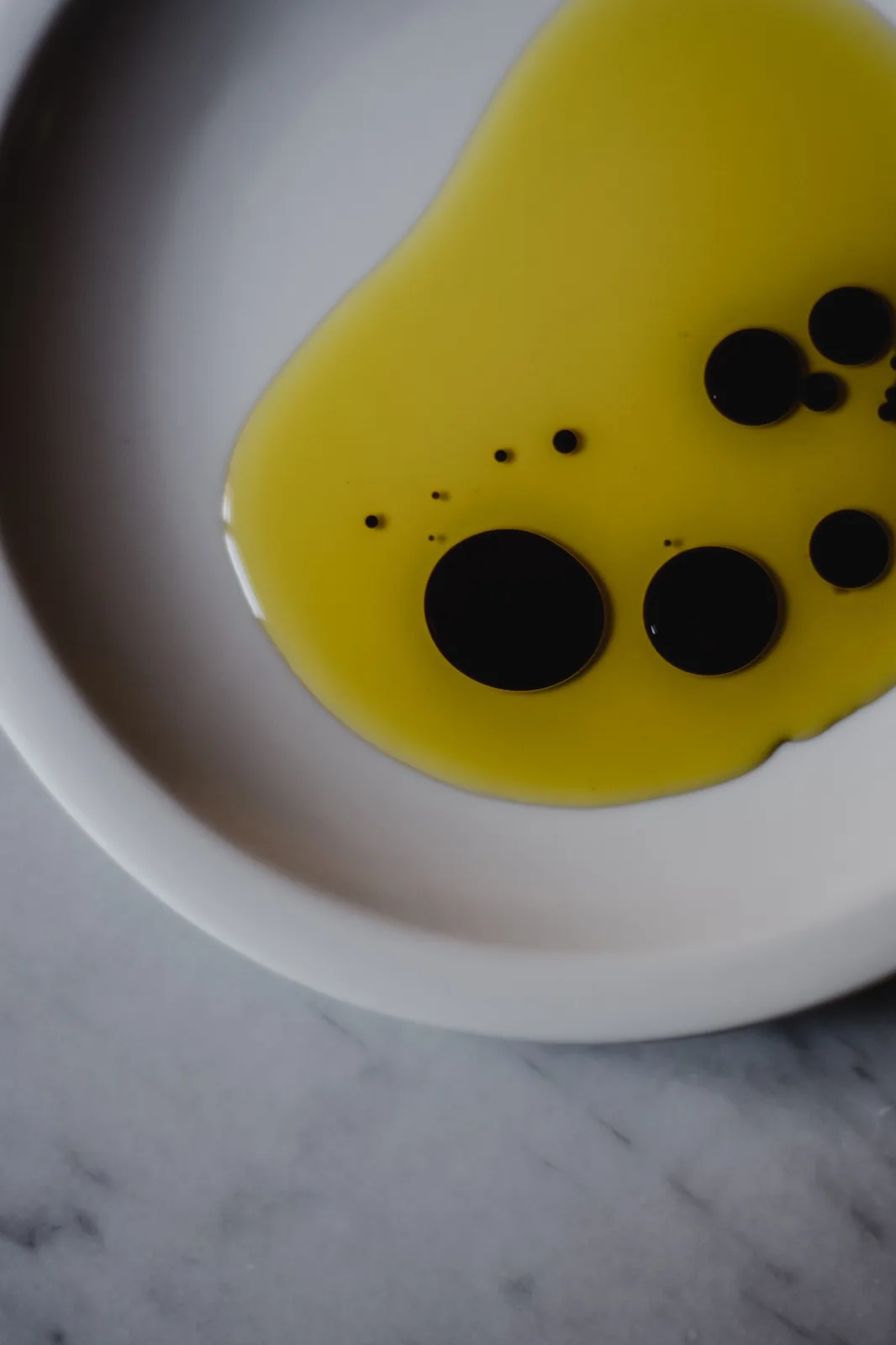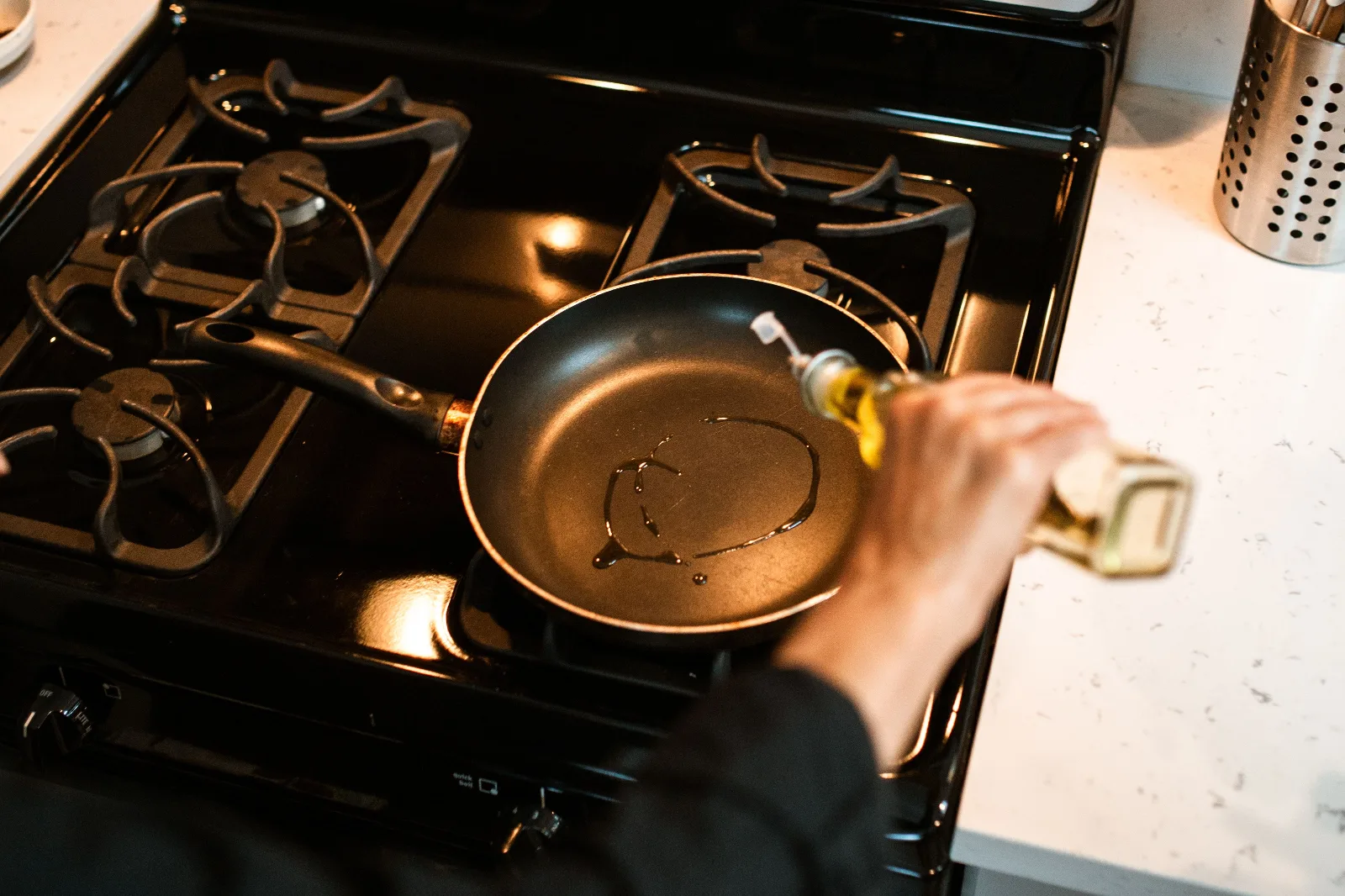
The argument you hear most often against frying with olive oil is the smoke point, a number that gets quoted a lot online and rarely explained. You can fry with extra virgin olive oil, and it stands up to the heat. What matters is how hot you let the pan get, what you are cooking, and how you treat the oil afterward.
Is extra virgin olive oil good for frying?
Yes. The International Olive Council (IOC), the intergovernmental body that sets the world trade standards for olive oil, calls olive oil particularly suitable for frying. It puts the ideal frying temperature at about 180°C. The Council also exists to promote olive oil, so it is fair to ask what research says. Two lab studies, from Australia and Portugal, point the same way: olive oil held up better under heat than sunflower oil, canola oil and a vegetable oil blend. Both are described in the next two sections.
Keep the heat moderate. Oils break down faster the hotter they get, and olive oil is no exception.
Heat is not the only thing that wears oil out, though. The IOC lists others: how long the oil stays hot, how many times it is used, what you fry in it, and how you fry. Frying in one continuous go is generally gentler on the oil than repeated rounds of heating and cooling. So oil heated once, not too hot, for a single batch of food, avoids most of these.
What about the extra virgin olive oil smoke point?
The IOC puts olive oil's smoke point at around 210°C. The smoke point is the temperature at which a heated oil starts to give off a thin, steady stream of smoke, as a 2025 study of virgin olive oils defines it. The figures you find online for extra virgin olive oil disagree widely, and part of the reason is the oil itself. A smoke point depends greatly on acidity, one of the measures used to grade olive oil: the lower it is, the later the oil smokes.
A 2018 study by De Alzaa, Guillaume and Ravetti shows how much acidity matters. An extra virgin olive oil with very low acidity (0.17%) began to smoke at about 207°C, while a virgin olive oil with about seven times as much (1.24%) smoked at about 175°C. The same researchers then heated ten supermarket oils for six hours at 180°C in a deep fryer. Sunflower and canola oil smoked much later than the extra virgin, near 255°C, yet broke down more. After the six hours, the extra virgin measured 10.5% polar compounds, the standard gauge of how worn a frying oil is. That was about half the sunflower oil's 21.75%, and less than the canola's 17.3%. Their conclusion: in their tests, the smoke point did not predict how well an oil held up under heat.
It is one study. The authors work for an olive oil testing lab owned by an Australian producer, they tested one supermarket product of each oil, and they cooked no food in it. A longer Portuguese study, below, found a similar pattern.
Olive oil vs vegetable oil for frying
The difference comes down mostly to the kind of fat in each oil. Extra virgin olive oil is largely monounsaturated fat, which stands up well to heat. Sunflower oil is mostly polyunsaturated fat, which breaks down faster. A 2022 study in the journal Foods measured supermarket oils: the extra virgin olive oil was about 72% monounsaturated fat, the sunflower oil about 60% polyunsaturated. Canola oil, sold as rapeseed oil in much of Europe, sat in between. The IOC makes the same point: oils high in polyunsaturated fat change faster when heated.
Long frying tests agree. In 2010, Casal and colleagues in Portugal deep fried in several kinds of olive oil until each one was worn out. The olive oils lasted 24 to 27 hours of frying, a shop-bought vegetable oil blend only 15.
How hot should the oil be?
The right frying temperature depends on the food. The International Olive Council gives three ranges:
- 130°C to 145°C for foods with a lot of water, such as vegetables, potatoes and fruit.
- 155°C to 170°C for anything coated in batter, flour or breadcrumbs.
- 175°C to 190°C for bite-sized foods that cook quickly, such as small fish or croquettes.
Fries need their own care. Acrylamide is a substance that forms when starchy foods brown at high heat. The EU's rules on it require the makers of cut potato products to give cooking advice on the pack: keep the oil between 160°C and 175°C and cook only until golden yellow. In Regulation (EU) 2017/2158 that advice names no particular oil, so the same temperatures apply whichever fat you fry in.
A kitchen thermometer takes the guessing out, and it costs little. Without one, cook on medium heat, and if the oil starts to smoke, turn it down.
Can you cook with extra virgin olive oil on high heat?
You can, but a pan on full heat gets hotter than you might think. In a study of ordinary home pans, published in 2014, researchers heated the pans to 200°C and then added breaded poultry. On high heat the pans climbed to between 235°C and 330°C, well above the 190°C top of the IOC's frying ranges. On medium heat most cooled below 200°C, some to about 150°C.
For a quick sear, heat the pan, add the oil, and get the food in soon after, rather than leaving the oil alone in a hot pan.
Refined vs extra virgin olive oil for frying
Shops in the EU can sell four kinds of olive oil: extra virgin, virgin, a blend of refined and virgin olive oil, and olive pomace oil. Under Regulation (EU) No 1308/2013, refined olive oil on its own cannot be sold to shoppers, so the bottle many guides call refined is usually that blend, sold as "olive oil composed of refined olive oils and virgin olive oils". We explain the four in What is extra virgin olive oil?.
Both the blend and extra virgin can go in the frying pan. The blend has a milder taste and usually costs less. In the Portuguese study, it held up about as well as extra virgin over long frying. Extra virgin tastes of olives, and some of that taste comes through in the food, though heat softens it. For eggs, potatoes, fish and vegetables, where you notice the oil, extra virgin is worth using.
How to deep fry with olive oil
Deep frying with olive oil works. The Portuguese study tested olive oils in deep frying, and the Australian lab heated its oils in a deep fryer. A few habits make the biggest difference:
- Use enough oil. The IOC advises enough for the food to cook evenly, so the oil does not burn easily.
- Heat the oil before the food goes in. The Council warns that food added to oil that is not hot yet can soak up extra oil.
- Pat the food dry. Wet food makes hot oil spit.
- Fry in small batches, so the oil stays hot.
- Lift the food onto a rack or paper to drain.
Is frying with olive oil healthy?
At home temperatures, frying in olive oil is a reasonable choice. Three worries come up most often.
Trans fats. In the 2022 Foods study, potatoes were fried ten times at 180°C in five oils, extra virgin olive oil among them. Trans fats rose a little in every oil but stayed under 0.25% of the fat in all of them, an amount the authors call negligible for health.
Fumes. Hot oil gives off vapors. One substance in them, acrolein, is classed by the International Agency for Research on Cancer as probably carcinogenic to humans. That rests on animal studies and lab work on how it damages cells; the evidence in people was too limited to judge. Two studies from the same lab disagree on which oil gives off the least (Fullana's team in 2004, Katragadda's team in 2010). Both found more fumes the hotter the oil, which is one more reason for moderate heat and an exhaust fan or an open window.
Fried food and your heart. A 2012 study in the BMJ followed 40,757 adults in Spain for about eleven years. Those who ate the most fried food were no more likely to have coronary heart disease or to die during the study. The result was the same whether they cooked with olive oil or sunflower oil. The authors note that it may not hold where food is fried in solid or reused fats.
Does frying take away the flavor and antioxidants?
Some of both, yes. Heat strips much of the fresh, green aroma of a good oil: in a 2024 study in Foods, an hour in a 180°C oven removed over 90% of the main compound behind that smell.
Polyphenols, the natural antioxidants of extra virgin olive oil, also fall with heat. In a 2020 study, Lozano-Castellón and colleagues sautéed extra virgin olive oil: its polyphenols dropped by 40% at 120°C and by 75% at 170°C. The temperature mattered more than the time.
Not all of it is lost. In a 2015 study, Ramírez-Anaya and colleagues fried and sautéed potato, tomato, eggplant and pumpkin in extra virgin olive oil. The vegetables ended up with more of these compounds than they started with, partly because they passed from the oil into the food. Boiling the same vegetables in water lowered them.
Can you reuse olive oil after frying?
Yes, a few times, if you look after it. The IOC generally advises reusing it no more than four or five times, and not mixing it with other fats or vegetable oils. A Spanish study by Gómez-Alonso and colleagues found the oil started to break down quickly from the sixth frying on.
To keep used oil in good shape:
- Let it cool a little, then pour it through a fine sieve or cloth to remove bits of food.
- Keep it in a closed jar, in the dark and away from the stove.
- Oil you have fried fish in, especially oily fish, may not last as many uses. The IOC notes that frying fish can make oil break down faster.
- Keep track of how many times it has been used.
Throw the oil away when it smells strong, smokes heavily at your usual frying heat, foams a lot, or has turned very dark. Those are the usual signs, according to a 2019 study of frying oil in restaurants, published in Food Science and Nutrition. The same study, of 50 fast food restaurants in Tehran, found that most of the oil they threw away was already more degraded than Iran's standard allows, so when in doubt, change it sooner. Darkening is the hardest sign to read: experts do not agree on how dark is too dark, because color also depends on the oil and the food. Let the oil cool, then take it to a collection point for used cooking oil rather than pouring it down the drain.