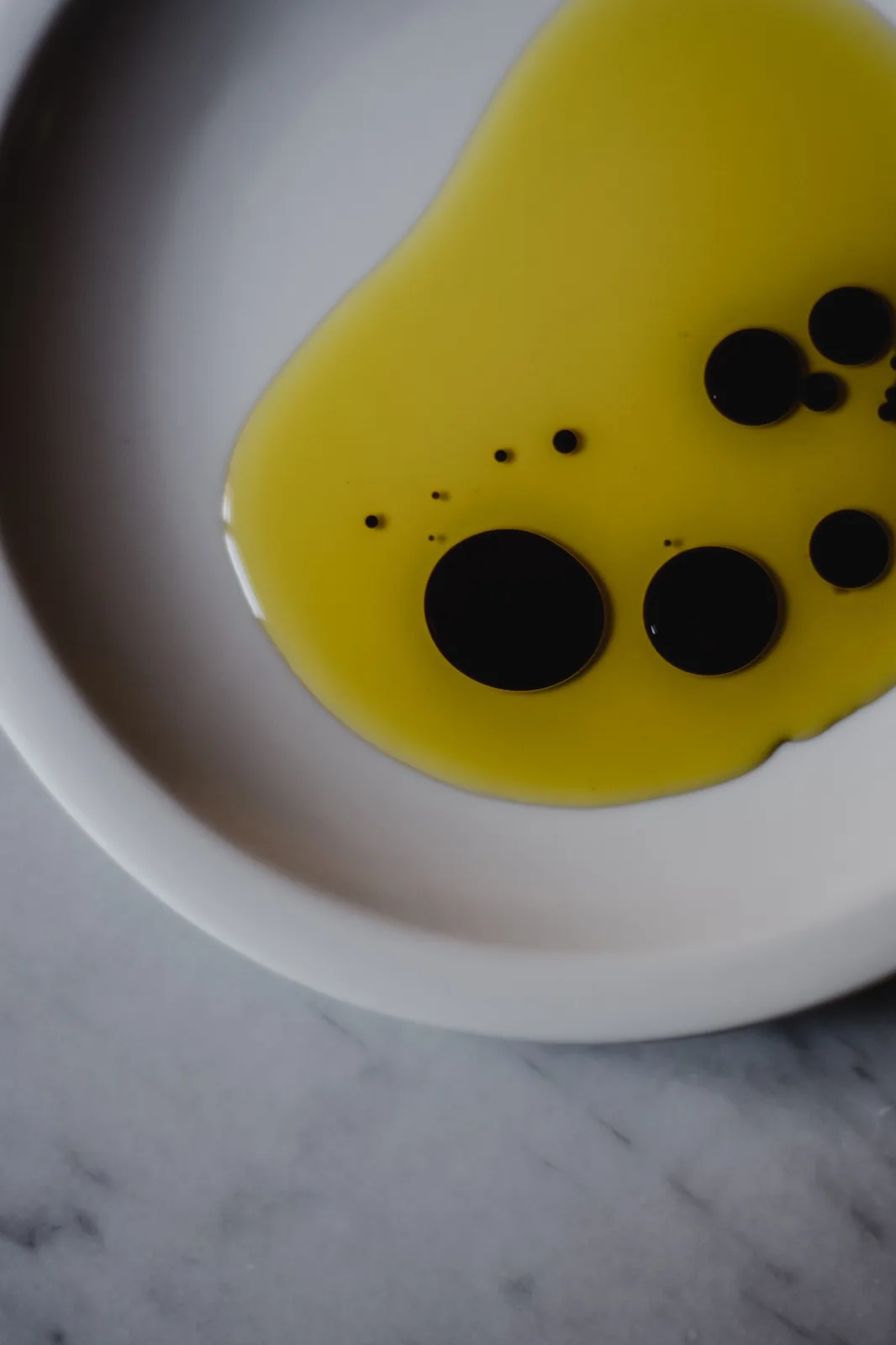
"Extra virgin" is printed on bottles of olive oil at every price, from the cheapest store brand to the one kept behind glass at the deli. The words have a precise legal meaning. They also guarantee less than most people think, and that gap is how a fresh oil and a tired one end up side by side on the same shelf, with the same grade on the front.
What is extra virgin olive oil?
Extra virgin olive oil is the top grade of olive oil in EU law: oil taken from olives by mechanical means alone, with free acidity of 0.8% or less, that also meets a set of laboratory limits and the tasting standard applied by a trained panel. The EU's common market rules define the category and set the acidity ceiling, Delegated Regulation 2022/2104 sets the other laboratory and tasting limits, and Implementing Regulation 2022/2105 sets how they are tested.
What it is made of is simple. At the mill the olives are washed and crushed into a paste, which is stirred slowly so the droplets of oil can gather, and the oil is separated from the water and the solids. No solvent, no refining, no chemical treatment. The label must say so in a fixed sentence: "superior category olive oil obtained directly from olives and solely by mechanical means."
Mechanical extraction only gets an oil through the door, though. Every virgin olive oil, the good ones and the poor ones, is made by mechanical or other physical means alone. Two sets of limits decide the grade: one for chemistry, one for taste.
The lab tests: what each number measures
Annex I of Regulation 2022/2104 lists the limits. The quality limits look for damage, to the fruit before milling or to the oil after; a longer list of purity limits checks that the oil is olive oil and nothing else.
- Free acidity, 0.8% or less. When olives are damaged, attacked by olive fly or kept warm too long before milling, enzymes split fatty acids off the fat. A low figure is one sign the fruit was sound and milled quickly. Acidity is a laboratory measurement, and a low figure says nothing about flavor on its own; that is the panel's job.
- Peroxide value, 20 milliequivalents of oxygen per kilogram or less. Peroxides are the first products of oxidation, the slow reaction with air that ends in rancid oil. A high number means the oil has started down that road.
- Ultraviolet readings, K232 of 2.50 or less and K268 of 0.22 or less. According to the International Olive Council's method, these readings pick up compounds formed by oxidation or by refining, which is how a laboratory spots an old oil, or a refined one sold as virgin.
- Ethyl esters, 35 milligrams per kilogram or less. They form when olives are damaged or start to ferment before milling, and one study found they track acidity only poorly.
The purity tests read the oil's fatty acids, sterols and waxes, which work like a fingerprint. Waxes, for example, are used to catch oil blended with pomace oil. The rule behind all of them is strict: if a single value falls outside its limit, the oil changes category or is declared non-compliant.
How the tasting panel grades an oil
The second examination is done by people, and the law treats it as a limit like any other. A panel of eight to twelve trained tasters, working to the council's sensory method, tastes coded samples from dark glasses so the oil's color cannot sway them. Each taster scores the intensity of any defects they perceive and of the positive attributes described below. For extra virgin, the panel's median score for defects must be zero and its median for fruitiness above zero. Official checks use approved national panels, and a company that disputes a result can ask for two more panels to taste it.
The defects have plain names, and each points to a cause, most of them a mistake in handling or storage:
- Fusty or muddy sediment: olives that fermented in a pile without air, or oil left standing on its own sludge.
- Musty: moldy olives, or earthy ones that went to the mill unwashed.
- Winey or vinegary: fermentation with air.
- Frostbitten olives: fruit damaged by frost.
- Rancid: oil that has oxidized heavily.
The panel scores three positive attributes: fruity, bitter and pungent. The method describes bitterness as typical of oil from green olives or olives turning color, and pungency, a biting sensation, as typical of oil made early in the season from mostly unripe fruit. If a bitter oil has ever put you off, the standard takes the opposite view.
Extra virgin vs virgin olive oil
Virgin olive oil is the grade one step down, made the same way. The limits are looser: free acidity up to 2%, slightly higher ultraviolet readings, and slight defects allowed, up to a panel median of 3.5.
Olive oil grades explained: the four you can buy
The EU recognizes eight categories of olive oil, and only four of them may be sold to you in a shop:
- Extra virgin olive oil. Defined above.
- Virgin olive oil. Mechanical, with slight defects allowed.
- Olive oil composed of refined and virgin olive oils. The bottle sold simply as "olive oil", with acidity up to 1%.
- Olive pomace oil. The paste left after milling still holds a little oil. That oil is recovered with solvents or physical means, refined, and blended with virgin oil. It must be sold under its own name and may not be called olive oil.
The other four may not be sold to consumers. Lampante oil is still a virgin oil, but its acidity is above 2% or another chemical or sensory value falls outside the virgin limits, so it must be refined before anyone eats it. Refined olive oil is the base of the blend above. Crude and refined pomace oil are the steps behind the pomace oil on the shelf.
Extra virgin olive oil vs olive oil, light and pure
Plain "olive oil" is refined olive oil blended with some virgin oil, and the law sets no ratio. Refining removes defects, and with them most of the smell and taste, which is why virgin oil is added to give the blend its olive taste. Extra virgin is never refined.
"Light", "extra light" and "pure" are not grades. The EU list of categories is closed and contains none of them, and in EU nutrition law "light" is a claim reserved for foods with at least 30% less of a nutrient or of energy than a similar product. In the United States, FDA rules let "light" describe color or flavor, stated next to the word, instead of less fat or fewer calories. Whatever the front of a bottle says, the legal category name on the label is what you are buying.
Cold pressed vs cold extracted: what the terms mean
Two temperature phrases are defined in law, in Article 10 of Regulation 2022/2104, and both may appear only on extra virgin or virgin oil made with the olive paste kept below 27°C:
- "First cold pressing" is reserved for oil from a first mechanical pressing on a traditional hydraulic press, where the paste is spread on mats and squeezed.
- "Cold extraction" covers oil separated below 27°C by a centrifuge or by percolation.
In Spain, about 92% of the olive oil industry separates the oil with a two-phase continuous centrifuge, and centrifuged oil sold as cold pressed olive oil should, in legal terms, say cold extracted. Neither phrase is compulsory, and the grade itself sets no temperature: an oil made from a warmer paste is still extra virgin if it passes both examinations.
What temperature changes is less tidy than the marketing suggests. In one study, warmer paste changed the oil's aroma compounds while the standard oxidation readings barely moved. Studies of the bitter and pungent compounds disagree: one found warmer paste lowered them in Cobrançosa oils, while another found the opposite in four Italian varieties.
What the label doesn't have to tell you
The law is strict about how the oil was made and what it tastes like when graded. It asks much less about the questions a buyer has next.
When it was made. A harvest year is optional. It may appear only if all the oil comes from that harvest, written as the season ("2025/2026") or the month and year of harvest. No bottling date is required. EU law requires a best before date on every bottle, chosen by the company that sells the oil under its name, and the European Court of Auditors found that in Italy bottlers commonly set it 12 to 18 months after bottling, not after the olives were milled. Nothing in EU rules stops oil from different harvests being blended.
Where exactly. Origin is compulsory on extra virgin and virgin oil. An EU country, or the EU itself, named as origin must be both where the olives were harvested and where they were milled; when the two differ, the label has to say "obtained in" one country "from olives harvested in" the other. Oil from several countries may simply read "blend of olive oils of European Union origin", or of non-EU origin, or of both.
Which olives. The variety is optional.
How good. Extra virgin is a floor. An oil with the faintest hint of fruit passes, and so does one that smells of a whole hillside.
The numbers. An acidity figure may not appear on its own. The regulation allows it only next to the peroxide, wax and ultraviolet values, in the same size, as maximums expected at the best before date, because acidity alone "wrongly suggests a scale of absolute quality". Words such as "robust", "medium" or "delicate" are allowed only when a panel assessment backs them.
Why bottles labeled extra virgin fail tests
An extra virgin oil has to stay extra virgin until its best before date, and inspectors take samples from the shelf to check. Oil keeps changing after bottling: light, warmth and air push it slowly toward rancidity. An oil bottled already close to its category limits and given a long best before date is more likely to slip before it is used, the auditors noted in their January 2026 report. Across the risk-targeted EU checks it reviewed, 93% of chemical analyses were compliant, against only 68% of tastings, and about a third of the oils found in the wrong category had simply degraded.
Recent tests point the same way:
- In January 2025 the Czech food inspection authority SZPI reported that 8 of the 18 oils it checked failed, and seven of those sold as extra virgin were a lower grade.
- In May 2026 the Czech consumer organization dTest tested 14 lower-priced extra virgin oils. A third failed their category on taste, with a muddy or moldy sediment defect, although their chemistry was within the limits.
- In its May 2026 issue, the German consumer magazine Öko-Test rated 30 oils labeled extra virgin; seven failed, some with rancid or fusty defects.
What it looks like from one grove
For our own oil, most of the questions a label leaves open have short answers. The olives are Koroneiki, all of them, picked by hand from one family grove on the hill above Petalidi, in Messinia. Olive growing runs in the family. The olives go to the mill the day they are picked and are cold extracted below 27°C. An independent laboratory confirms the acidity is under 0.8%.
The current stock is from the 2025/2026 season, the most recent pressing; our label doesn't print it.
How to tell if olive oil is real
No home test can prove an olive oil is real extra virgin. The popular fridge test, where real oil is supposed to turn solid, failed when the UC Davis Olive Center tried it in 2013: none of the samples set after 60 hours in a refrigerator, whatever their quality. Only a laboratory and a panel can grade an oil.
What you can notice at home is freshness and the defects the panel looks for. Pour a spoonful into a small glass, cup your hand over it for a minute to warm it, then smell. A sound extra virgin oil smells green or ripe, of things such as tomato leaf, apple or almond. Rancid oil smells of stale walnuts, crayons or wax, the descriptors a UC Davis Olive Center report gives for it. Vinegar, wine, or a heavy fermented smell like olives forgotten in a bag point to the defects above.
Then take a small sip and pull a little air in with it. Look for bitterness and pungency. Pungency rises and falls with a phenolic compound called oleocanthal, and phenolic compounds fall as oil ages: one study of 160 extra virgin oils measured an average drop of about 42% after a year in the dark at 20°C. An oil that tastes of nothing cannot be extra virgin, since the grade needs some fruit: it has been refined, blended with refined oil, or faded with age.
Color is no guide to quality: it comes from pigments that vary by variety and fade as olives ripen. Keep the bottle away from the stove and the window, close it after use, and finish an opened bottle while it still tastes the way it did on the first day.
Taste a few different bottles side by side this way, and before long your nose will tell you more than the front label does.